| August 24, 2026 |
NatNews |
ISSUE 232 |
JOURNALING AS A FORM OF SELF-CARE + MENTAL HEALTH BENEFIT
|
Teenagers sitting in their rooms starting entries with “dear diary” might have the right idea. The University of Rochester Medicine asserts that journaling can be beneficial for mental health by offering a healthy way for individuals to express themselves when feeling overwhelming emotions. Writing such feelings down can help people manage anxiety, reduce stress, and cope with emotions. “Journaling can be a great way to organize and reflect on your thoughts and emotions,” Dallas resident and psychologist Kenleigh McMinn said. “We’re often too busy throughout the day and may not be mindful of what is going on for us internally. Setting aside dedicated time to write gives your brain a chance to decompress.” Consistently writing in a journal can also allow a person to become more self-aware, recognize triggers for certain feelings and behaviors, identify stressors, and acknowledge fears and anxieties. “While there are other ways to do this, journaling can be particularly helpful because it creates something visual and can help view your thoughts differently,” McMinn said. “Seeing them on paper often provides a bit more distance and wider perspective than when they are floating around in your mind more abstractly.” Individuals use journals in a variety of ways, including to note reasons to be thankful, as part of their faith journeys, as places to share thoughts they don’t want to speak out loud, determine goals and intentions, track progress and growth, and for many additional purposes. “For me, journaling cultivates gratitude as I record my blessings,” Dallas-area resident Cristy Brandenburg said. “It increases my self-awareness by allowing me to see patterns in my thoughts and emotions and recognize triggers so that I can deal with them. Journaling allows me to slow my thoughts down as I record them. This makes space for God to speak to me about them.” |
Journaling doesn’t necessarily look the same for everyone. There’s no standard template or structure, and no one is going to come through and proofread it for spelling and grammar mistakes. As Brandenburg noted, writing in a journal isn’t an activity reserved for an exclusive group of people. “I think journaling can be helpful to anyone,” she said. “The key is knowing there’s no right or wrong way to do it.” And for Brandenburg, putting pen to paper for only her eyes to see has become a spiritual experience. “Finding freedom to record thoughts, emotions, and experiences without being graded or judged makes journaling a safe space to learn more about yourself and grow closer to God,” she said. The components of one’s journal can remain between the person and the pages—private thoughts written down that serve as a form of self-care and potentially create feelings of peace in a sea of chaos. And as Brandenburg previously mentioned, McMinn further echoed the sentiment that there is no one way a person is required to transfer the activity in the mind and heart to paper. “Everyone’s process for journaling can look different,” she said. “Some people can write freely and jot down their streams of consciousness. Others do better using bullet points to keep it more organized. And a lot of people do better with journals that provide some specific prompts since it can be tough to know where to get started.” |
DID YOU KNOW?
|
Butterflies taste their food using special chemical sensors called chemoreceptors on their feet. |
APPROACHING PEOPLE IN THE WILD
|
In a highly digital world, it’s not uncommon to look around at a social setting and see individuals not interacting with those they don’t know. Many people are hesitant to approach others while out and about for the fear of being rejected. After all, from the brain’s perspective, such an emotional pain is quite similar to that of a physical ailment. There are also additional factors that keep individuals from interacting with one another. Fort Worth resident Marc Hall said he is an outgoing person who can talk to pretty much anyone, though he noted that his willingness to strike up conversations with others he might be interested in is often contingent upon where he is at the time. Hall, who was born and raised in Dallas, said he thinks that the city has changed quite a bit over the last few decades in terms of the social environment, and people seem more guarded and focused on aspects such as appearances and status, which he believes can lead to individuals making quick judgments rather than simply having conversations. “What makes me think the environment plays such a big role is how different my experiences are when I travel,” he said. “In a lot of places, people seem more open to random conversations, and there’s less of that initial sizing each other up. I’ve noticed that since moving to Fort Worth, too. I’ve met a ton of people simply by talking to them while I’m out. So, I think where you are and the culture around you can have a pretty big impact on how people interact.” For some individuals, general shyness can certainly play a role in hesitations to be casually chatty. Dallas resident Morgan Fritz said she would not feel comfortable approaching someone she doesn’t know out in public and initiating a conversation. “I am a quieter person, and this would be so far out of my comfort zone,” she said. “I’m trying to be more open, though, so that people feel like I’m open to talking to them if they were to come up to me.” And if someone did walk up to Fritz unexpectedly, her level of ease would be contingent upon a few factors. “I think I feel more comfortable if it’s as natural as possible or related to something around us or the activity we’re doing (coffee shop, etc.), rather than just approaching and immediately jumping into expressing interest,” she said. “It might be too much of a cold start for me.” Dallas-area resident Ashley Hill, though, said if a man came over and started talking to her in the wild, she would be flattered, no matter what. “Depending on if the vibe was there or not would depend on how I would let the conversation flow,” she said. “If it were someone I was interested in, I would definitely be open to giving him my number. If I weren’t interested, I would still be polite and make short conversation. I think it’s a really hard thing to approach a stranger, so kudos to anyone who does that.” And for Hill to be the one initiating the conversation, she said it would depend on the situation. “If I were at a Dallas Cowboys game with some girlfriends and there was a group of guys, then I probably would say something,” she said. “If I were sitting in a restaurant and saw a guy across the room, then probably not.” And just because someone strikes up a conversation with another individual doesn’t mean there will be or needs to be a love connection. Hall said he is open to others approaching him, as life is short, and he believes that a significant part of it is interacting, having a variety of experiences, and hearing how other people see the world. “I like meeting people and learning what makes them different from me,” he said. “I also don’t think every interaction needs to turn into something. Maybe there’s mutual interest, maybe you make a friend, or maybe you just have a great 10-minute conversation with someone you’ll never see again. I’m good with all of those. Sometimes a good conversation is enough.” Recent studies have revealed that individuals are socializing less than they were in the past, largely as a result of people spending more time on their smart phones as well as an increase in remote work and people spending more time at home.
|
Hall said he isn’t completely convinced that individuals have simply become less social, noting that he thinks that people’s environments and the habits they develop because of those environments have significant impact. However, he added that he does believe that phones, social media, dating apps, etc. have likely contributed to social habits changing in a way that people don’t have unexpected encounters as often as they used to in the past. “We’ve gotten used to knowing something about someone before we decide whether we want to interact with them,” he said. “When you meet somebody randomly, there’s no profile to look at first. You actually have to talk to them and figure out who they are. But I still think the regional and environmental part gets overlooked—I think our surroundings shape how we interact more than we realize. Put the same person in a different environment, and you may get a completely different response.” Similarly, Hill said she believes that social media and texting have heavily contributed to the way social interactions have changed. “It is crazy how much people ‘meet’ on Instagram these days or spend weeks texting and not actually hanging out in person,” she said. “I also think that people feel more comfortable giving someone a follow on Instagram versus approaching them in person. As a millennial, I prefer face-to-face interaction.” Hill certainly isn’t alone in that regard, as many millennials have complicated relationships with social media, using it often but also preferring in-person conversations. Fritz, who is on the younger end of the millennial generation, acknowledged that she also believes that social media plays an integral role in individuals being less willing to engage as easily with those around them. “We are connected with each other without actually being connected,” she said. “The overall culture is centered more on our connections on our phones and social media than connecting with strangers around us.” That doesn’t mean that individuals can’t alter the current reality and interact more with one another, regardless of what the motivation is behind such encounters. “I think that we should all focus on just being friendlier to those around us, not only if we want to date them or be their friend,” Fritz said. “The world is a better place when strangers are friendly without any expectation of a return.” For Hall, beginning conversations with others doesn’t need to be as complex or stressful as individuals often make it. “To me, the bigger question is how we get back to remembering that people are just people, and we’re only here for one go-round,” he said. Hall noted, however, that some people don’t wish to converse, and that needs to be respected. He acknowledged that initiating a conversation doesn’t require someone to give his or her time or attention, and there doesn’t necessarily need to be an expected outcome. “I think we’ve gotten to a point where we sometimes make simply talking to each other more complicated than it needs to be,” he said. “I’d rather be open to people and see what happens. Maybe it’s a two-minute conversation, and that’s it. Maybe you hear a perspective you’ve never considered. Maybe you make a friend. Maybe there’s an attraction. Or maybe you meet someone who ends up becoming an important part of your life. You just don’t know—and I think we miss out on a lot when we decide what an interaction means before we’ve even had it.” Oprah Winfrey once said “I believe that one of life’s greatest risks is never daring to risk.” When it comes to engaging in a conversation with someone who strikes her fancy, Hill would be on the same page as Oprah. “I think if you see someone you are interested in at a coffee shop or at the gym, then you 100 percent should shoot your shot,” she said. “The worst someone can tell you is no, and life goes on. Or it could be the person you are meant to be with, and you will never know if you don’t try to make a face-to-face connection with them.” WEEKLY PHOTO OP 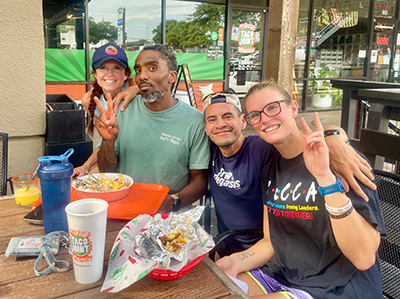    .jpg)  Cupcakes, tacos, and smack talk are a winning combo |
| Upcoming Events |
Monday, August 24: Free Cult Classic Movie Monday — 10 Things I Hate About You at Sundown at Granada |