| November 16, 2026 |
NatNews |
ISSUE 244 |
OVERCOMING OVERTHINKING PATTERNS
|
Overthinking is a common response to stress, and while the brain’s natural ability to analyze situations is helpful, it becomes less beneficial when occurring excessively, keeping a person in an ongoing loop of worry. Overthinking can involve rumination (revisiting recent or past mistakes, conversations, or situations with feelings of regret or self-blame) and/or worrying, which can create a sense of overwhelm and anxiety. Analyzing the same thought, decision, or situation repeatedly can cause a person to become stuck in a cycle of negative thinking, and being able to pinpoint when such thoughts are unhelpful is an important component of ridding of that endless loop. There is such a concept as healthy reflection, which allows an individual to consider a situation, draw a conclusion, and move forward. However, there is a vast difference between healthy reflection and overthinking—healthy reflection has an endpoint, while overthinking does not. Research indicates that worrying and overthinking about a situation lessens the chances of reaching a viable solution. Dallas school counselor Olivia Wetzel noted that revisiting the same thoughts pertaining to an occurrence or interaction is certainly not uncommon. “I feel everyone experiences some form and/or experiences situations that lead to overthinking,” she said. “Some people may experience this more than others or more often. Overall, overthinking is a common experience that most people can slightly relate to.” Wetzel acknowledged that overthinking can become an issue when it turns into dwelling on bad thoughts or ruminating on situations. “This can be a common experience or component for individuals with anxiety and/or mood or panic disorders,” she said. “However, learning how to recognize thoughts that can lead to overthinking spirals of negativity, anxiety, and shame is the first step to building up coping strategies that best support the person experiencing the thoughts.” And while it can affect some individuals more often than others, Wetzel acknowledged that overthinking doesn’t discriminate. “Most individuals may experience overthinking in some way throughout their lives,” she said. “However, individuals who have anxiety or other mental health conditions may experience it more frequently and more severely than someone who does not. Individuals who have high-stress careers may experience this more frequently, as well. Also, people who grew up watching a parent, caregivers, or other adults overthink may catch themselves in those same patterns or recognize it in themselves and others more often.” |
Being caught up in one’s thoughts in such a way can be addressed and stopped, though. Wetzel said she doesn’t believe that there is a one-size-fits-all strategy to overcome moments of overthinking, as different individuals will respond to different approaches. However, she does have various recommendations that can be effective. “If someone is finding themselves to be stuck in overthinking, I strongly recommend talking to a therapist,” she said. “One thing I share with students (and teachers) who may be anxious and overthinking is to practice a pause. Do not draw any conclusions or make any decisions right away.” Wetzel also said it can be beneficial to distinguish between facts and feelings by explaining or writing down the scenario or thought as it happened or noting the main points. “Do the facts match the feelings? It’s OK if they do not,” she said. “However, this may highlight if the individual is helping amplify a negative narrative in their head compared to what actually happened.” Wetzel noted that another helpful tactic she often uses is running through the best-case and worst-case possibilities, asking “What is the best thing that could happen, and what is the worst?” She follows that question with “How would you (or how do you think you would) respond to both the best and worst thing that can happen?” “It’s almost like a dress rehearsal for your brain,” she said. “Overthinkers’ and anxious minds’ kryptonite is reassurance. You are braver than you know and stronger than you think.” Wetzel added that one strategy a person should not employ is to say “calm down” or “you’re overthinking it” to someone who might be ruminating over a situation. “That can come off as dismissive and invalidating, especially if the thoughts center on something stressful or negative,” she said. “You can help a friend out by simply listening, offering your perspective appropriately, and asking how you can best support.” |
DID YOU KNOW?
|
Camels don’t actually store water in their humps; rather, their humps are made of fat, which they can metabolize into energy when food is scarce. |
LIKE ROBIN SPARKLES, LET'S GO TO THE MALL
|
Life is filled with constant changes, and even places that once held meaningful space in people’s lives can fade in importance. The mall used to be a common meeting spot for friends and a go-to destination for individuals needing new apparel or other items from specialty shops that fit their lifestyles. While malls certainly still exist, they are not as thriving as they once were and have experienced declines in retail sales. Dallas resident Rafa Aguilar said he visits the mall about once a month, though sometimes less often, depending on whether he has something he needs to purchase there or not. However, like many adults, he was a much more frequent mall-goer in his younger years. “I loved walking around and running into people I knew,” he said. “Going to the mall felt like an experience in itself. Even shopping for something random was fun because you never knew who you might see there.” Like Aguilar, Dallas resident Jenny Schultz said she goes to the mall once a month, if that. She shops more often at local smaller businesses, doing so once or twice a week. She was also a regular at the mall during her pre-teen and teenage days and said she enjoyed hanging out with friends and spending the money she had earned babysitting. “It was a right of passage to go to the mall and see a movie, do a bit of shopping, and grab some food,” she said. “Most malls also had several price points available to shop, so my babysitting money could go far.” Malls can also bring about nostalgia in other ways than time spent wandering with friends. Schultz said she had a special connection to NorthPark Center mall in Dallas because her grandmother used to take her on a shopping spree for Schultz’s birthday each year. “Every time I go to NorthPark and hear the fountain and see the ducks and turtles with my children, it reminds me of her,” she said. “It still smells the same, and especially at Christmas time, I love to see my boys enjoying some of the same displays that I did growing up.” There are other reasons to trek it to a mall than for shopping or cruising around with one’s pals, though. Dallas-area resident David Recker said he finds himself at the mall approximately every two weeks, though it’s mostly to go to the food court and to see movies, as the movie theater he and his fiancée go to is at the mall. If that were not the case, Recker said they would likely not go to the mall at all. Growing up, though, he was a self-admitted certified mall rat. “I mainly just went to hang out with my friends,” he said. “I didn’t do a lot of shopping, per se, but a lot of my friends worked at the mall, so we’d always naturally find ourselves there.” In the Dallas area, multiple malls have met their demise. Some notable mentions include Valley View Center in Dallas, (which is supposedly going to become the new home arena of the Dallas Mavericks), Collin Creek Mall in Plano, Six Flags Mall in Arlington, Big Town Mall in Mesquite, Prestonwood Town Center in North Dallas, and now the Shops of Willow Bend in Plano (which is still potentially going to be the home of the new arena of the Dallas Stars, though Plano voters rejected a recent proposition for such a possibility). Recker said he thinks that malls have been fading out because they used to be designed as a central hub of activity, as opposed to the strip malls that have become common now. “I also grew up in a much smaller town than I live in now, and there wasn’t as much for teenagers to do,” he said. “I think I’ve also aged out of the bracket of it being ‘cool’ to hang out at the mall. When we go now, we still always see teenagers, so I think it’s still a popular place to go, just not with my demographic.” Amazon (as an online bookstore) and eBay both launched in 1995, and Amazon grew in popularity in the early 2000s when it introduced third-party marketplace sellers. Now, approximately 288 million Americans shop online, spending an average of $4,280 per shopper each year. Aguilar noted that he believes that online shopping plays a significant role in individuals not venturing out to local malls as often.
|
“People can buy almost anything without leaving the comfort of their homes, so there’s less reason to go,” he said. “There’s also a bigger focus on finding deals and comparing prices. When people know they can get something cheaper online, shopping in person becomes less appealing.” Schultz said she grew up frequenting malls such as Valley View, Prestonwood, NorthPark, and the Galleria with her parents, while she and her friends more often gravitated toward Grapevine Mills and Vista Ridge. She added that it makes her sad to see the decline of shops in the Galleria and Vista Ridge and the total loss of Prestonwood and Valley View. “My dad still walks at Vista Ridge and says it is thriving in other ways, and I have hopes for the redevelopment of Valley View, but I think it is always a bit hard to see bits of your childhood gone or drastically changed,” she said. “I like the changes we are seeing in outdoor shopping centers such as Southlake Town Square and more mixed-use areas. I think spaces like Southlake draw in more people.” Like Schultz, Aguilar said it hurts his heart a bit that many malls have closed or are closing and are being replaced by other infrastructure or facilities. “For many of us, the mall was a safe, comfortable place to meet friends, walk around, and spend time together without needing a specific plan,” he said. “It’s sad to think that younger generations might not get to experience that in the same way.” While malls aren’t completely obsolete, and there are potential reasons for hope to remain alive, Aguilar noted that it’s not likely that they will hold the same significance as a third space as they did in the lives of so many individuals years ago. “I think malls will still be around, but I’m not sure they’ll become the go-to hangout spot they once were,” he said. “Stores will need to stay competitive with online prices and keep up with changing trends. Otherwise, I think we’ll continue to see more of them close.” For some people, the mall lifestyle of the past is simply something that should remain in the past. Recker said he generally doesn’t pay much attention to the fading power of the shopping mall. “I think they’re still ‘cool’ to certain age groups,” he said. “I’m just not one of them.” Schultz acknowledged that despite malls not serving the thriving purpose they once did, she does have hope that the mall, in some form, will be a desired place for people to spend time again. “Malls can be a place for family and community, not just for errands,” she said. “I like what Grapevine Mills has done by adding an aquarium and LEGOLAND. NorthPark has local schools come perform and community groups that have events there. They also have a branch of the local library that has a storytime, and CASA hosts the playhouse exhibit and raffle each year.” Schultz said the examples above are all opportunities that give the space dual purpose and make the mall have a greater impact on the community as a whole. She also believes that perhaps a certain ice cream staple of her youth needs to have its carts return in all of their glory to mall walkways. “Youth of a certain age love to shop and hang out at malls—they just need to have a reason to go,” she said. “Dippin’ Dots was always a big draw for me, so maybe they should give that a go.” WEEKLY PHOTO OP 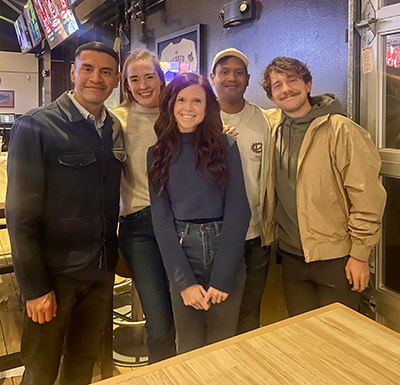      NatNews staff and dear readers watched the Cowboys lose again |
| Upcoming Events |
Monday, November 16: National Button Day |