| September 28, 2026 |
NatNews |
ISSUE 237 |
UTMB: "YOU'VE EITHER DONE THE WORK, OR YOU HAVEN'T"
|
The mantra “I can do hard things” looks different for everyone—and for some people, it means completing one of the most challenging trail running races in the world. Occurring at the end of August each year, Ultra Trail du Mont Blanc (UTMB) begins and ends in Chamonix, France, and follows a route around Mont Blanc in the Alps, traversing through three countries before returning. Dallas resident Keith Jensen crossed the finish line of UTMB this year, noting that he has always been drawn to finding out where his limit actually is. After running the Grand Canyon rim to rim to rim in October 2024, Jensen said he remembers thinking “I can go farther than this.” Ultimately, that post-Grand Canyon thought eventually led him to UTMB. “When I first saw it, it honestly seemed ridiculous,” he said. “It’s 108 miles around Mont Blanc—through France, Italy, and Switzerland—with 33,000 feet of climbing (more vertical gain than climbing Mount Everest) and 33,000 feet of brutal descents. I had no idea whether I could do it. And that was exactly what drew me to it.” Jensen said he didn’t want another challenge he knew he would be able to finish. “I wanted something big enough that I could prepare for years, give it everything I had, and still fail,” he said. “UTMB gave me that.” The buildup to UTMB became a two-year project for Jensen. A former collegiate athlete, he had been a serious runner most of his life, but he said he knew this particular endurance race required building a completely different kind of athlete. Speed wasn’t going to get him around Mont Blanc—rather, he needed to become incredibly durable. Jensen said he logged thousands of miles running and biking, endless hours hiking at 15-percent incline on a treadmill, trips to the mountains, back-to-back long days, running through the night, strength work, nutrition, recovery, and learning how to take care of his body through all of the normal aches and pains that come with that much training. “Eventually, I stopped thinking about UTMB as this enormous thing I had to conquer,” he said. “I thought about moving one grain of rice every day. Train today. Recover today. Eat right today. Then wake up tomorrow, and move another one. For two years, I did that. Nothing heroic—just thousands of small decisions pointed in the same direction. By the time I got to the starting line, there was a lot of peace in knowing I had done everything I could. Now I just had to find out if it was enough.” Jensen acknowledged that though he was confident, he was also scared. “I think both of those things can be true at the same time,” he said. “I knew I had prepared as well as I possibly could, but I also had enormous respect for what I was about to attempt. There are a million things that can go wrong during a race of this distance over this kind of terrain. The closer we got, though, the calmer I became. At some point, there is nothing left to train or fix. You’ve either done the work, or you haven’t.” As with many situations in life, unexpected plot twists often arrive. In this case, it was in the form of a massive storm that rolled through Chamonix the day of the race, pushing back the start by two hours. Jensen said the unrequested circumstances almost felt fitting. “After two years of trying to control every variable I possibly could, the mountain immediately reminded me that it was in charge now,” he said. “Before the start, I told [my wife] Christina, ‘I’ll be right back.’ Then it was simple: start moving, take care of yourself, solve problems when they show up, and keep moving forward.” |
Some (probably many) individuals might have trouble imagining the difficulties one might face throughout and the overall challenge (both physically and mentally) of completing a race of more than 100 miles through mountainous terrain, but even someone who has achieved such a feat can’t always convey it so easily. “There are no words in the English language to express how hard UTMB is,” Jensen said. “It was also one of the most beautiful experiences of my life. After 108 miles, 33,000 feet of climbing, and two nights in the mountains, everything gets stripped down. Eat. Drink. Move. Solve the next problem.” Jensen acknowledged that while his climbing remained strong, his legs eventually began to struggle on the descents. But despite any pains his body felt throughout the journey, he said his spirit remained positive, and he never experienced a dramatic moment in which he wanted to call it quits. “There were just moments when continuing was really hard,” he said. “So I made the world smaller. Finish this climb. Get to the next aid station. Take care of yourself. Keep moving forward.” Jensen said toward the end of the race, he saw a sign that read “You could always do it. But now you know,” and it was an affirmation that rang true with him. “For two years, I had believed I could finish UTMB,” he said. “Now I knew. That feeling I had, alone in the dark, knowing I was going to finish after 30+ hours, was something special I will remember for a long time.” But the most impactful moment came at the end of the race. Jensen’s family, including his wife, son (Jett), parents, mother-in-law, and father-in-law, traveled across the world for him and were waiting for him when he made his way to the finish. He acknowledged how Christina had lived the goal with him the past two years and never made him feel guilty for what it required. His dad studied the course and logistics and essentially stayed awake for two days to crew for Jensen through the Alps. Jett was part of the training itself, riding his bike alongside his dad for more than a thousand miles. “I was the one wearing the bib, but there is no version of this story where I did it alone,” Jensen said. “For two years, we talked about Jett running the finish with me. Thirty-seven hours after I left Chamonix, I came back, and there he was. He grabbed my hand, and we ran together to the finish. That moment ended up meaning more to me than the finish itself.” While finishing UTMB didn’t change who Jensen is as a person, he said it altered his relationship with what he thinks is possible. Two years prior to the race, he said he genuinely didn’t know if he could do it. “I didn’t start with some incredible belief in myself,” he said. “I started with a question. Then I spent two years answering it—one workout, one long run, one uncomfortable day, one grain of rice at a time.” Jensen said finishing UTMB gave him a different kind of confidence—the confidence that he doesn’t need to know whether he can do something before he begins. “I can choose something that scares me, respect how difficult it is, do the work, and give myself the chance to find out,” he said. “That’s what UTMB gave me.” |
DID YOU KNOW?
|
A group of giraffes is called a tower when they are standing still and a journey when they are traveling along together. |
MOVING TO A NEW CITY AS AN ADULT
|
While change can often be beneficial in several ways, it can also carry tremendous uncertainty—especially when it requires a person to leave a city behind and embark on a journey somewhere new without the comfort of familiar faces along for the ride. The most recent available data shows that 11.8 percent of the U.S. population (between approximately 25 to 26 million individuals) changed residences in a given year. Included in that demographic are those who made rather big moves to new cities all by themselves. While doing so can be intimidating for some people, it’s often necessary as a result of career opportunities, fresh starts, or other life changes that simply warrant new surroundings. Alicia Wyatt has lived in a total of 10 states, with a handful of significant solo moves: at age 18, she moved from Medford, Oregon, to Cheyenne, Wyoming for college; at age 26, she moved from Phoenix, Arizona, to Philadelphia, Pennsylvania, because she wanted to move to the Northeast after getting divorced; at age 35, she left Philly for Dallas for a job opportunity; at age 44, she moved from Dallas to New York City because she wanted to be back in that area of the country; and most recently, she relocated to Connecticut and is enjoying a quieter pace surrounded by nature (while still close enough to NYC). Wyatt said there are two distinct challenges that stand out among others when relocating to a new city by oneself. The first is knowing the best area of the city to call home. “If you are moving to a new place, it can be hard to pick where to live from online listings,” she said. “You really do have to explore the area a bit to see which part of the city suits you the best.” The second difficulty, Wyatt noted, is building a new network of friends and service providers. “These networks become so second-nature to us once they are established that we underestimate how challenging it can be to rebuild them from scratch,” she said. “Finding pet sitters has always been one of the hardest service providers to replace when I move.” And then there is the aspect of making friends as an adult, which can already be trying at times, particularly in a new place where people have built longstanding connections prior to a new person’s arrival. Wyatt said it’s beneficial for her when she makes efforts to establish a new routine and then incorporate her hobbies once she becomes more familiar with the area. She enjoys running, Latin dancing, and horseback riding, and she said she has met new people by joining groups and meetups in which she can participate in such activities. “This helps because you are meeting people with similar interests to you, and that helps give a stronger foundation for building a friend network,” she said. “I have networks of friends all over, so I also ask if anyone can facilitate an introduction in the areas I am interested in. A lot of my moves have been for work, so I also lean on recommendations from work contacts for local service providers, general city knowledge, restaurants to try, and local events that are good to check out. Don’t be afraid to try or join something new.” More than a year ago at the age of 28, Andres Covarrubias moved from Houston to Dallas for his career. He said one challenge he experienced in coming to a new place on his own in his adult years was losing the support and social systems he had previously. “Before, I had people I could call on if I needed a hand while moving or someone to watch my cat while I was out of town or if I wanted to gather some people for a night out,” he said. “Moving to Dallas reset all of that for me. It was especially hard leaving my friends and family—not only do I miss them, but I feel that the longer I stay away from them, the more we grow apart. I still try to keep up with them through phone calls and occasional visits, but it’s just not the same.”
|
Prior to his move, Covarrubias said he began researching various run clubs in Dallas as a way to continue a hobby he enjoys while connecting with others at the same time. Once he made it to his new city, he went to some of those groups to get a better idea if they were the right vibe he was seeking. “This ended up being a good way to put myself out there socially while also being able to explore the city since the clubs were dispersed throughout the cities’ municipalities,” he said. “I also reached out to some old college friends whom I haven’t seen in years to catch up and try to establish a basic social network, and I was lucky enough to find someone at work who was able to transcend being a ‘work friend’ to being a real friend.” Making such concerted efforts were an integral part of the process of Covarrubias finding a community to socialize with on a regular basis, which he said he believes is a critical step to a mentally healthy life. “Humans are fundamentally social creatures and depriving yourself from interaction only leads to bad things,” he said. “With the rise of the social internet, the locality of the community has become less important. I am still able to keep up with my friends and play video games with them online, but I believe that it doesn’t fully replace meeting up with people in a third space to share a common interest.” Wyatt said she also thinks that building community is important and can help one feel connected to a new place and potentially introduce that person to something new he or she hasn’t experienced before. However, she noted that she believes that it is better when not forced. “Put yourself in situations to meet new people and connect,” she said. “Be brave and ask someone new to coffee, because you never know whom you may really connect with. It is good to be open to opportunities.” Wyatt, who has not only lived in 10 states but has also traveled to 47 out of the 50, noted that she has lived in big cities and small country towns, which she believes gives her a more well-rounded perspective of the U.S. and challenges that arise in different instances. She said it also makes her constantly curious about new places. “Every city has its own rhythm, and I enjoy learning about the feel of each one,” she said. “It can be lonely if you are moving alone, but that can also help you really be immersed in the new culture you are learning and building. I think these experiences have made me a very adjustable person and someone who enjoys finding new festivals and exploring local farmers markets.” Covarrubias said moving to a new city on his own has allowed him to make discoveries about himself (such as how confident he is in his cooking abilities now that he has a kitchen all to himself) that he didn’t necessarily realize prior to doing so. He added that the relocation to Dallas has also let him shake some preconceived notions of who he was in the context of his life back in Houston. “Making new friends has really shown me what I value in a friendship,” he said. “Trying new restaurants has shown me what flavors I truly enjoy. Going to novel events has let me experience firsthand what I find fun, instead of just doing what my friends want to do. It’s like spring cleaning for the self—sometimes you have to get out with the old and make way for the new, and whatever sticks around is who you truly are.” WEEKLY PHOTO OP 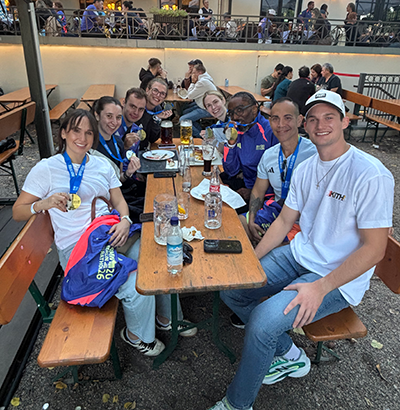    .jpg)  Some NatNews dear readers recently gathered in Berlin for a marathon and other antics |
| Upcoming Events |
Monday, September 28: Free Cult Classic Movie Monday — Zoolander at Sundown at Granada |