| July 20, 2026 |
NatNews |
ISSUE 227 |
IMPACTS OF ANXIETY + FINDING RELIEF
|
If you’ve ever found yourself feeling overwhelming anxiety, you are not alone. According to the National Alliance on Mental Health, in the U.S., anxiety disorders are the most common mental illness, impacting approximately 40 million adults 18 years and older annually. The Anxiety and Depression Association of America notes that anxiety disorders can stem from several different factors, including genetics, brain chemistry, personality, and life events. While anxiety disorder involves persistent, excessive, and uncontrollable fear that interferes with a person’s daily life, job, and relationships, many individuals experience occasional anxiety in a variety of situations. Dallas resident and counselor Lucy Keith said it’s important to remember that anxiety does not need to be viewed in a negative light. “It’s your body’s and mind’s natural fear response to a perceived threat, stressor, or uncertainty,” she said. “Like any emotion (there are no bad emotions), it’s signaling for your attention and wants to tell you something. In manageable doses, anxiety can be helpful for focus, preparation, and motivation.” However, Keith noted that when a person’s anxiety feels chronic, out of proportion to the perceived threat or stressor, persists when the threat or stressor has passed, or impacts the individual’s day-to-day functioning, he or she should consider seeking help. “In the short term, anxiety can impact performance and well-being across a number of physical, emotional, mental, and relational arenas,” she said. “In the long term, anxiety can increase your risk of chronic pain, high blood pressure, cardiovascular disease, and substance abuse. Anxiety is also a very prevalent pairing with depression.” Different individuals can often experience anxiety in different ways, both physically and emotionally. Keith said anxiety can present itself physically through an increased heart rate, shallow breathing, muscle tension, sweating, or an upset stomach, while the emotional aspect can involve fear, hypervigilance, irritability, overwhelm, and various thoughts (e.g., those related to what might happen, worst-case scenarios, rumination, etc.). For many individuals, anxiety becomes a significant struggle and can be helped through therapy. “Slowing an individual down to increase their awareness of these interconnected experiences and their initial triggering event is a common first step in treatment, and in doing so, you can begin to apply healthier coping skills, physical grounding, and cognitive strategies to find relief sooner,” she said. “Beyond that, there are several evidence-based modalities proven effective in treating severe anxiety, and what works for one person won’t work for another. A number of biopsychosocial factors must be taken into account. It’s best to receive a full assessment and treatment plan from a licensed professional.” However, Keith added that there are certainly actions individuals experiencing anxiety can take on their own to help support their nervous systems and manage their mild-moderate anxiety through the basics—sleep, sunlight, exercise/movement, nutrition, connection with others, reducing screens/social media, etc. |
“The goal is never to remove all stressors from our modern lives—that’s not happening,” she said. “Through better care for ourselves, we increase our capacity for stress.” Various forms of exercise—whether running, walking, strength training, cycling, yoga, Pilates, or other forms of movement—often allow people to de-stress and find a bit of relief from anxiety. Keith said exercise is beneficial for several reasons, but when it comes to anxiety, one of the first thoughts she has her clients consider is how movement gives their anxious energy somewhere to go. “When the threat or stressor is perceived, your body literally starts to do things to help you prepare to ‘fight or flight,’” she said. “You have adrenaline pumping through you, your breath shallows and quickens, blood pumps to the extremities, you sweat (initiates cooling your body), digestion slows (conserves energy)—all of this is done to help you either fight or run away.” Keith added that such types of movement can come in a variety of forms. Simply getting the body in action allows it to function as it needs. “When feeling anxious, bust out 50 jumping jacks,” she said. “Do air squats. Drop down for push-ups. Dance. Shake. If you have more time and space, go for a brisk walk, sprint, or jog. Just move. Let the stress cycle complete itself.” A recent American Psychiatric Association mental health poll revealed that U.S. adults are experiencing increasing anxiety, noting current events and the economy as key contributors to such feelings. With a rise in anxiety, especially with stresses and impacts caused by social media and digital connectivity, there has also been a reduced stigma of talking about anxiety and bringing its effects to light. But whatever the catalyst to creating such feelings within a person, anxiety is nothing new to the human experience. “We are wired with the same survival instincts and the same sense of belonging that the earliest humans had,” Keith said. “Except today, instead of a lion chasing you, it’s your boss in your face, conflict with a family member, endless responsibilities, notifications, and financial stress.” Keith added that even the ways individuals compare themselves is similar to those of people in the past, though it’s on a much grander scale now. “Instead of comparing yourself to your small village or tribe to determine if you’re contributing enough and protected enough not to be outcast (and, therefore, likely not to survive), we compare ourselves and our lives to strangers all over the world,” she said. “Modern life is less ‘do or don’t’ but arguably filled with far more threats and overstimulation to our systems.” If you do struggle with anxiety, there are several resources, including therapy, available to help. You can also check with your insurance provider to find counseling options offered in your coverage. |
DID YOU KNOW?
|
The original Ferris wheel, created by structural engineer George Washington Gale Ferris Jr., was introduced at the 1893 World’s Fair in Chicago. |
HOW MUCH DO YOU RELY ON A NAVIGATIONAL APP?
|
For many individuals, gone are the days of printing out MapQuest routes, trying to read a giant paper map that needs to be folded over 14 times after use, or stopping at a gas station when your nonexistent internal compass begins to fail your navigation abilities. Raise the praise hands for maps apps. Options such as Google Maps, Apple Maps, Waze, or another navigation assistant replaced now seemingly antiquated tools, including TomTom, once a pioneer in consumer GPS technology. Google Maps has now become the most used navigation app globally, offering not only directions but also live traffic intelligence and business information, among other extra components. Individuals have become rather reliant on such maps they can access on their phones so simply. One American survey found that more than half of the 2,400 participants indicated that they would not feel confident driving anywhere if they weren’t able to use GPS to help them navigate. Dallas resident Abby Cartwright said she opens her phone’s map app essentially every time she gets in her car. “I mostly use Apple Maps for navigation when I’m going to a new place, but I also often plug in directions to familiar places as a force of habit and/or to avoid traffic,” she said. Cartwright acknowledged that, like many other drivers, trying to navigate various routes without the use of GPS technology would be quite a challenging feat. “It’s embarrassing to admit, but I’ve become so reliant on Apple Maps that I think I would struggle to get to places without it,” she said. “It would definitely require more brain power to think through the roads I’d have to take. I feel the need to plug in directions even when I’m going to familiar places in case I get distracted and miss a turn.” Dallas resident Silvia Obregon also uses Apple Maps frequently, noting that doing so is mainly so that she can not only know where she’s going or the best route to take but also so that she can ensure that she arrives at her destination on time. “It helps me plan my commute and calculate arrival,” she said. Obregon, who has lived in Dallas for four years, added that she could avoid getting lost in some instances without Apple Maps, though she relies on the app much more in areas with which she is less familiar. “I would be able to get around to the places I frequent, but as a non-Dallas native, I still need help getting around the metroplex,” she said. Overall, Obregon said she thinks that maps apps are positive additions to drivers’ lives, as they help them get to their destinations more easily. “They also provide a sense of safety in the event we need to be rerouted,” she said.
|
Dallas resident Terran Tran opts for Google Maps and said he uses the app on a daily basis, even when he knows where he is going, as he likes to know what his arrival time will be. “I use it mostly for just checking traffic,” he said. “I don’t go to many places, so I go to the same places every day (work, home, grocery store). I put it on every time mainly for traffic, and it’s nice to have it on the side in case of road closures.” Tran added that it would be difficult for him to get to a place he has never been before if he weren’t able to use Google Maps and joked about his lack of experience with non-technology navigation. “I’m sure I could learn how to use a physical map, but there’d be a learning curve,” he said. “I’ve never used a physical map in my life.” There are certain safety concerns and potential frustrations that come with GPS navigation apps, as they can cause drivers to be distracted and even lead them astray when directions are confusing or inaccurate. However, Tran said he believes that maps apps are more beneficial than they are not. “It gets people to the places they need, and I feel like people would get lost more often without them,” he said. “I can see why it’d be a problem if we’re too reliant, but we should utilize the technology we have.” Cartwright, on the other hand, acknowledged that though she appreciates being able to use mapping apps because of the convenience they afford, she thinks that they actually have an overall negative impact. “They reduce our critical thinking and geospatial skills, and I think that extends beyond navigation tasks,” she said. Cartwright cited studies regarding taxi drivers and their reliance on knowing the areas in which they drive rather than on technology. In London, to obtain a taxi license, a driver must pass a test that requires the person to know the names and locations of 25,000 streets as well as various landmarks and businesses. Brain-imaging research revealed that London cab drivers have unusually large hippocampi, the area of the brain responsible for spatial memory and navigation and where degradation occurs in individuals with Alzheimer’s. Harvard Medical School researchers further investigated such findings and determined that while more research is needed in this regard, it would benefit drivers to rely less on navigational systems and use the hippocampus as part of their daily lives more for potential positive effects in the future. “I’ve read that taxi drivers in London get Alzheimer’s at much lower rates than the rest of the population because they have to use their brains so much to navigate the city streets,” Cartwright said. “Because most of us never have to use our brains for those kinds of tasks anymore, I have to wonder how that will impact us in old age.” WEEKLY PHOTO OP 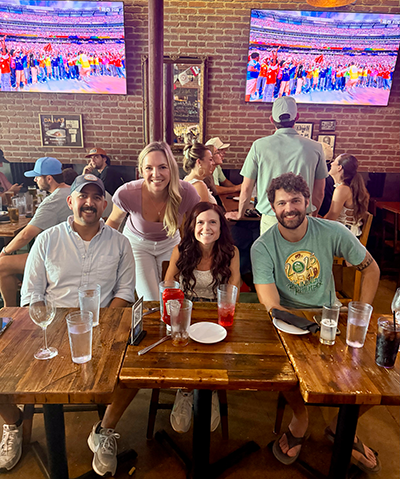    .jpg)  Contrary to some beliefs, no Hillside Tavern managers are pictured here |
| Upcoming Events |
Monday, July 20: Daniel Caesar at the American Airlines Center; register for the Katy 5K (code “NATNEWS” gets you a discount) |