| May 25, 2026 |
NatNews |
ISSUE 219 |
DON'T SAY YOU'RE TOO BUSY TO READ THIS
|
It’s not unusual to hear a certain word many individuals commonly use to describe themselves: busy. Whether actually swamped with items on to-do lists or simply looking to avoid various interactions or conversations, some people use the term without thinking much about it. While it’s likely true that plenty of people are legitimately busy, sometimes the idea of being busy or actually remaining busy becomes a standard. When individuals complete tasks, their brains release the pleasure hormone dopamine, which makes them experience positive feelings. It’s easy to become addicted to that feeling, so the pattern repeats as people continue to crave the feeling that being busy and accomplishing tasks provide them. Dallas-area resident and licensed professional counselor Jenna Meister said she thinks that “busy” has become somewhat of a status symbol in today’s current culture, as many individuals associate being busy with being important, successful, productive, or needed. “When someone says they are constantly working, overcommitted, or running from one thing to the next, it can almost sound like proof that they are accomplishing something meaningful,” she said. “Social media has reinforced the idea that slowing down equals laziness, while stress and exhaustion often seem to be treated like badges of honor.” Dallas resident Braden Keefer said he believes that the word “busy” has been overused for a long time, as it makes individuals feel more significant and interesting. However, he added that he doesn’t believe that the use of the word is done so insincerely. “I personally used to use that word often to make people think I was more interesting than I was in the moment,” he said. “Conversely, when I was actually busy, I would still say I was busy. I also think we do this to avoid sounding like we are lazy. I think there’s this false notion in America and the world over that if you are not busy or not doing anything, you are lazy. That is complete horse s***.” Keefer added that just because a person is not occupied at the time does not mean that the individual is a slacker or non-go-getter, and he advises people not to concern themselves with opinions of others who would think such a way. “Something a good friend‘s father told me once is that it is a privilege not to be busy and to have nothing to do,” he said. “You can only be so busy for so long before you burn out and the quality of whatever you’re doing suffers. It’s important to have a schedule filled with things that you need to do and want to do, but it shouldn’t be constantly overwhelming to the point where all you do is work or have something on your plate that’s taking up an insane amount of time.” Sometimes, being busy can be used as an excuse to avoid dealing with personal issues or relationship problems. When a person’s mind has downtime, the individual is left with his or her own negative feelings, which can make one feel anxious or depressed. Meister noted that remaining constantly busy can certainly take a significant toll on a person mentally, emotionally, physically, and spiritually. “When people rarely slow down, the nervous system stays in a heightened state for long periods of time,” she said. “Over time, that can contribute to anxiety, irritability, emotional exhaustion, sleep problems, depression, and even physical health concerns. For example, research points to prolonged stress being one root cause of many autoimmune disorders. Emotionally, people can begin to feel disconnected from themselves and from the people they care about most. Relationships often suffer because there is little margin left for rest, reflection, or quality connection.” Meister added that she thinks that chronic busyness can make it more challenging for people to recognize what they are truly feeling because they are always moving to the next task and that there is a deeper issue of identity that can develop in such a situation. |
“If someone’s value becomes tied entirely to achievement or productivity, slowing down can create guilt or discomfort instead of peace,” she said. “Healthy rest is necessary for emotional resilience, creativity, relationships, and overall well-being.” Chronic busyness can also lead people to forget to make time for taking care of themselves in ways that benefit their mental and emotional health, whether because one is seeking distraction from or avoidance of certain feelings or simply trying to pile too much onto his or her metaphorical plate. However, as Meister said, she thinks that many individuals are allowing themselves to pack on mental loads that are not sustainable in the long term, particularly as a result of the current world in which we live. “Technology has also made it difficult to truly disconnect because work, responsibilities, news, and social expectations follow us everywhere,” she said. It’s also possible that many individuals simply are not as busy as they claim to be. Keefer said he thinks that people often use the term as a cop-out to avoid certain situations or to present themselves as more important and valuable. “It would be better if we all just said ‘hey, I don’t want to do this’ or ‘I don’t want to allocate my time here’” he said. “With that said, I also think that we, as people, tend to bite off more than we can chew to please other people or to maintain a social appearance when a lot of the tasks that are making us busy don’t really matter to us.” While people tend to make time for the things for which they want to make time, it can be challenging to keep priorities in order. Keefer said he thinks that most people do prioritize the things they want to do and spend the most time doing those things, though he added that people often try to prioritize more than they can handle. “This is something I am also guilty of, and I’m actively trying to improve and do better,” he said. “Unfortunately, there’s only so much we can do as one person, so it’s important for our families, relationships, passions, careers, etc. to allocate time appropriately to get the most out of our lives.” Keefer added that it’s also important to note that just because a person doesn’t prioritize something doesn’t mean that the individual doesn’t care about it. “It also doesn’t mean that those priorities can’t change,” he said. “It just means that at that moment, that thing might need to be shelved until you have more bandwidth.” Despite various lofty goals and idealized lifestyles, people are simply human and can only do so much. Meister said she thinks that many people are simply trying their best, but priorities can become distorted by pressure, fear, comparison, or survival mode. “Things like work, achievement, financial stress, and external expectations can easily take center stage, while emotional health, relationships, faith, rest, and personal growth get pushed aside,” she said. But Meister added that she truly believes that people do not intentionally neglect what matters most to them. “Life is just loud,” she said. “Over time, urgent things start replacing important things. I think most people value family, connection, peace, and purpose, but their daily lives do not always reflect those values because they are overwhelmed or stretched too thin.” |
DID YOU KNOW?
|
Queen termites can live up to 30 years, though some African species can survive for up to 50 years. |
HOW IMPORTANT IS IT TO KNOW YOUR NEIGHBORS?
|
It’s quite possible that Mr. Rogers would have liked to see an improvement in people’s familiarity with their neighbors. According to a Pew Research study conducted last year, approximately 26 percent of U.S. adults said they know all or most of their neighbors, while 62 percent know only some of them, and 12 percent don’t know any. Regarding how much individuals trust those who live near them, 44 percent of adults indicated that they trust all or most of the residents in their neighborhoods, while 46 percent trust some, and 9 percent trust no one living around them. (It’s OK if you are also questioning where the missing 1 percent is.) Dallas resident Suzanne Woodling has lived in her current home for 14 years and said she knows many of her neighbors quite well, becoming acquainted with them as a result of working outside in her yard, walking her dogs, and engaging in friendly conversations in other various social situations. “I meet a lot of people when I’m out walking, and we have a pretty active neighborhood,” she said. “We also have a really good neighborhood association that does a lot of events, so you meet a lot of people when you attend. I am on the association board, and I help plan events and go to most of them. We also have restaurants, schools, and a community garden, so people are out and about going to all of these places, so you can’t help but interact when you start to see the same people everywhere you go.” Dallas resident Neil Smith recently moved from one condo to another and has been in his current new home for roughly two months. Despite being there only a short time, he already knows those around him rather well. “I moved to be near some of my best friends,” he said. “Because my friends have lived in the neighborhood for several years, they have introduced me to the rest of the neighbors.” In surrounding communities that are considered more family-friendly, couples and individuals with kids often form strong bonds with those who live near them. Dallas-area resident Ashley Farrell has lived in her current home in a local suburb for almost five years with her husband and their three children. For her, the neighborhood has created a sense of community and friendships. “In my neighborhood, I am talkative and friendly with the people who live directly next to me or down the street,” she said. “Within my whole neighborhood, I have a group of about eight families that I am very close to—talk to daily, give each other’s kids rides, have play dates, hang out with kids and parents. The parents I am closer to have kids the same age as mine, so a lot of our daily activities overlap.” For individuals who live in apartment complexes, it’s not incredibly uncommon to be unfamiliar with other residents and not interact with them much. Dallas resident Craig Borkenhagen has resided in his current apartment for approximately a year and a half and said he doesn’t know his neighbors well, though he has made previous efforts. “I’ve met my across-the-hall neighbor a couple times, and we’ve exchanged numbers,” he said. “There was an incident when I didn’t feel comfortable with their cameras they’ve set up—it felt like they were watching me. But they explained they had some packages stolen (some prior history with a different neighbor), and so all is good now for me. But I don’t really talk to them much ever. And then with the next-door neighbor, I dropped off some cookies one time and got the weirdest vibe from her. I think she was drunk or high—or both—at like 11 a.m.” Borkenhagen noted that one reason he believes that many individuals don’t know their neighbors and sometimes have no interest in getting to know them is simply a result of American culture. “We are very individualized here,” he said. “We look out for ourselves first. And with so many people living in apartments year to year, why get to know someone who’s going to be gone next year, anyway? Or I’m the one who’s going to be gone, so why forge such short-term relationships?”
|
There is also the reality that people are constantly moving from one activity to the next or choosing to allocate their time in other ways (see article above). “I think the reason people don’t get to know their neighbors is because everybody’s got such busy lives,” Woodling said, “and if you’re not out doing things like introducing yourself to your neighbors, walking your dogs, or working in your yard, you won’t meet as many. I also think it’s because Dallas has a very transient population.” While making friends as a child or adolescent is a natural occurrence, doing so as an adult can often be more challenging for a variety of reasons, including comfort in existing social circles, life changes, the requirement to make more efforts to engage with others, etc. Farrell said she thinks a potential reason people don’t always make concerted efforts to engage with their neighbors is a result of existing relationships with friends and family members who are nearby, particularly in well-established areas. “I think our neighborhood is unique in making friends because it’s all new builds, and with an elementary school in the neighborhood, there are age-similar families,” she said. “I also think people don’t care to make friends with their neighbors because their ‘communities’ exist in social media/online.” Like Farrell, Smith also said he believes that technology has certainly impacted neighborly interactions, noting that the digital era has left individuals increasingly isolated. “Your online friends can only type on a keyboard or click like,” he said. “They can’t help you change a tire, pick up a package from your front door, or keep an eye on your house.” But Smith stressed the importance of knowing the individuals within one’s surrounding community, citing an incident that recently occurred and further ingrained his notion of establishing and building neighborly relationships. “The first month that I lived in my new place, a neighbor had a fire in his house,” he said. “The neighbors stepped up to help him deal with the aftermath and settle into a new place.” Farrell also said she thinks it’s important to know one’s neighbors, adding that doing so has truly positively impacted her family’s life in several ways. “Moments are always made brighter by sharing with others,” she said. “I’m thankful I have a strong group to help with all things, like extra milk, watching my house while we’re gone, and helping with my kids.” When a person lives in a place in which he or she doesn’t share similarities such as family dynamics and life stages, natural neighborly relationships don’t come as easily. Borkenhagen said he believes that people should at least make efforts to get to know the other individuals living near them. “It’s what fosters community and a friendly atmosphere,” he said. “I’ve found that if I put in that little effort to get to know others, they see that and often reciprocate.” And Mr. Rogers might have been onto something regarding being part of a sacred experience by appreciating one’s neighbor. Woodling said a key component of knowing neighbors, in addition to feeling a stronger sense of safety, is being immersed in and developing one’s own special community. “Several studies show that part of the reason Japanese live so long is that they have a very tight-knit community,” she said, “and community has shown to increase happiness as well as life expectancy.” WEEKLY PHOTO OP 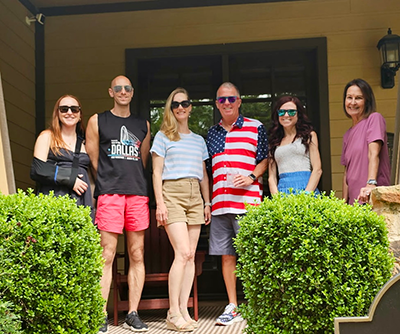    .jpg)  Another rendition of Scott’s movie night (minus Scott and minus a movie) |
| Upcoming Events |
Monday, May 25: Rangers vs. Astros at Globe Life Field |