Trouble viewing this email? Visit NatNews online to view this issue or any of our archived issues!
 

February 2, 2026

NatNews

ISSUE 203


STRETCH IT OUT FOR LONGEVITY

It is not uncommon to see people at the gym or before a sports or athletic competition of some sort stretching, often to warm up or loosen up their muscles and take extra concerted efforts not to pull any muscles. Younger individuals sometimes do not concern themselves with such precautions, but as people age, their bodies start to feel pains and twinges more often.

Stretching on a regular basis, though, can benefit a person in a number of ways and potentially improve longevity.

A recent NatNews research initiative found that 21 percent of polled respondents stretch at least daily, 24 percent stretch only before exercise, 45 percent do so on occasion, and 10 percent never stretch.

Dallas resident and licensed physical therapist Lyndsy Nevitt, who is also a certified Pilates instructor and owner of Bear PT & Pilates, said stretching helps keep balance in an individual’s body.

“Daily stretching prevents tightness that forms from compensatory patterns,” she said. “It allows muscles to give joints more room to work the way they are meant to work, thus decreasing odds of injury and strain. It is important to stretch after your body is warmed up. Stretching on too ‘cold’ of muscles could result in muscles not loosening up or even in injury if too forceful.”

Dallas-area resident, school counselor, and runner Olivia Wetzel said she incorporates stretching into her life on a daily basis. She describes herself as always being a “wiggly” kid and often had unique or “goofy” ways of sitting in chairs. She sometimes even preferred to stand or lie flat on her belly when she was completing her school assignments. Wetzel, who was previously diagnosed with ADHD, recently learned that she also has Hypermobile Ehlers-Danlos Syndrome (hEDS), which is a condition characterized by generalized joint hypermobility, joint instability, pain, and soft and hyperextensible skin.

“So, all of my wiggles and stretches were my body working to support itself,” she said. “I played tennis all through high school and college, so stretching was always a part of that, but stretching and movement is a part of my daily routine, even when I don’t realize it.”

Wetzel said she doesn’t have a set pattern or schedule for her stretching, but she does find herself performing small stretches and movements throughout the day. However, there are certain precautions she needs to take to ensure that she stays healthy and injury-free.

“Now, knowing about my hEDS, I have to be careful stretching because I can easily go past the correct range of motion and hurt myself,” she said. “I also use certain braces and resistance bands at times that help my body feel good.”


And while Wetzel said she doesn’t have the knowledge to declare certain stretches as being “key” for everyone, she knows it is important for each unique individual to determine what is best for him or her.

“Being a bendy person and having hEDS, learning how my body works and what is helpful and safe for my body has been key,” she said. “I think working with a physical therapist or trainer can be helpful for someone wanting to learn more.”

Nevitt, whose practice is located in Dallas on the east side of U.S. 75 between Mockingbird Lane and SMU Boulevard, said her two favorite stretches she thinks that everyone should perform help maintain mobility for the lower back and hips.

“A supine hamstring stretch and a supine figure four stretch are two that I think everyone could benefit from,” she said. “They are easy to do, and no equipment is needed, and in the supine position, you are in a safe place to maintain a nice neutral spine to prevent ‘cranking’ on your low back.”

Sitting for long periods of time and getting wrapped up in the daily stresses of life can lead to poorer posture and a decrease in mobility and the ability to rest easily. As such aspects are important to longevity, incorporating daily stretching into one’s routine can help counteract the physical strain modern life can often bring.

“As a counselor and someone who loves both movement and rest/recovery, mindful movement like stretching can certainly help calm the nervous system and improve body resilience,” Wetzel said. “If I see a stressed-out student, I usually offer a walk with me in the hallway, or I allow flexible seating in my office (sitting or stretching out on the floor). Also, using stress balls or something to squeeze helps, too. Mindful movement—I’m a big fan.”

Nevitt also said daily stretching can provide significant advantages and noted that it can certainly take on a form of meditation that can help boost longevity and overall well-being.

“For us to stop, slow our bodies, and breathe into the stretch could be very beneficial for everyone,” she said. “Stretching allows us to be still in each position and focus on moving slowly and sustaining that posture. This can provide a calming effect in a world of go, go, go.”


DID YOU KNOW?

Nylon fiber—one of the most used fabric materials because of its quality and durability—was first used as a material for fishing lines, 3D printing, packing foods, and building car engines.


RESEARCH SHOWS THAT TALKING TO STRANGERS CAN INCREASE OVERALL HAPPINESS

When you’re a little kid, for safety reasons, you’re often taught not to talk to strangers. As an adult, though, many individuals become more capable of discerning when it is OK to speak to people you don’t know.

And it turns out that such interactions can actually lead to an increase in happiness.

However, different individuals have different comfort levels when it comes to striking up conversations with strangers. Sacramento-area resident Ashley English said for her, it depends on the situation in which she finds herself.

“Sometimes it’s easier because they don’t know you, and you can put on your situational veneer, such as with polite business chatter or asking the person at check-out how they’re doing,” she said. “But prolonged situations with people I don’t know very well can be stressful. So, as long as I don’t feel like I’m in the hot seat and need the interaction to go well (like during a job interview situation or networking event), I’m good.”

Like English, Dallas-area resident Kyle Burnett, who describes himself as an ambivert (a combination of an introvert and extrovert), said his level of comfort in engaging in conversation with people he doesn’t know is also situational.

“I am notoriously shy and reserved around strangers, though,” he said.

For Dallas resident Adam Gribben, his affinity for talking to individuals with whom he is not yet familiar is less contingent on the situation and more so on the topic of the conversation.

“I am comfortable talking to strangers,” he said. “‘They are just us,’ as my tattoo artist niece would say.”

And because of his ability to feel comfortable starting conversations with people he doesn’t know, when Gribben finds himself in intentional social gatherings and situations, he doesn’t need it to be solely among friends and acquaintances and embraces the chance to turn strangers into non-strangers.

“I prefer somewhat of a mix, but I can get comfortable with a routine, such that the number of unknown people starts to become fewer and fewer,” he said

Not everyone is as willing to attend events in which they will likely be required to interact with unfamiliar faces if they don’t want to be completely antisocial, though. Burnett said he would much rather find himself in social situations in which he knows the other people around him.

“It’s just a comfort-level thing,” he said.

English said her likelihood of feeling at-ease is dependent upon what type of social engagement she is attending, as certain situations can cause her stress levels to increase more than others.


“I’m always a little anxious meeting new people, so a gathering with close-knit friends or family is certainly preferred, but in other situations, I may prefer to be meeting new people than getting together with people I know I don’t get along well with,” she said. “A mix is good, too, but may be even worse if it were mostly people I didn’t know and only a few I did. If everyone else knows each other except me, that’s probably my worst-case scenario—I’m getting anxious even thinking about it.”

A study in 2022 focusing on assessing the correlation of social encounters and happiness revealed that interacting with a more diverse set of relationship types predicts higher well-being. While interactions with individuals such as partners, family members, friends, etc. who are part of closer relationships offer greater opportunities for more authentic, substantive, and responsive conversations, interactions with colleagues and strangers—with whom people tend to have more surface-level conversations—can also result in unexpected positive experiences, according to the study.

While Burnett doesn’t doubt the findings of the study, he said they won’t impact or change his levels of comfort in his social interactions. 

“I’m sure that increased happiness is possible from talking to strangers, but it’s not enough to encourage me to do it,” he said.

Some individuals, including Gribben, though, see the link between the relational diversity of a person’s social portfolio (the richness and evenness of relationship types across the individual’s social interactions) and well-being as an opportunity to discover information about others and share personal anecdotes with them, as well. 

“I do believe speaking to people you don’t know could increase happiness,” he said. “You get to hear some new stories and get to retell some oldies but goodies.”

As the study indicates, relational diversity when it comes to one’s social circles—having a balance between close relationships and those that are more distant but still allow for engagement—can certainly be beneficial for a person’s overall well-being.

“That study makes sense to me,” English said. “Despite being shy, I do tend to be happier walking away from those random conversations struck up in the line at the grocery store or at the gym.”


WEEKLY PHOTO OP
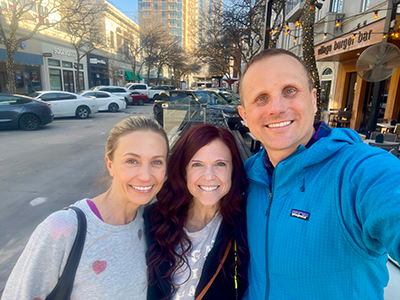
As a NatNews picture etiquette reminder, always get in the middle when you’re the third wheel  


Upcoming
Events

Monday, February 2: Stars vs. Jets at the American Airlines Center
Tuesday, February 3: Mavs vs. Celtics at the American Airlines Center; Free Rooftop Movie — Down to Earth at Sundown at Granada
Wednesday, February 4: Stars vs. Blues at the American Airlines Center
Thursday, February 5: Mavs vs. Spurs at the American Airlines Center; Karen Mills at Dallas Comedy Club
Friday, February 6: National Frozen Yogurt Day; Jared Freid at House of Blues Dallas; Billy Joel Tribute — My Life at Legacy Hall
Saturday, February 7: WRRC Saturday run from Taco Joint; Hot Chocolate Run at Fair Park; 13-Year Anniversary Party at Community Beer Co.; Dallasites101 9th Annual Cupid’s Crawl on Greenville Avenue; New Edition at the American Airlines Center
Sunday, February 8: Super Bowl LX on NBC/Peacock